


Gone in 60 Seconds: How to Stop Relay Attacks in Toronto With Faraday Pouches & Smart Key Fob Habits
You lock the car, hang your keys on the hook by the front door, and go to bed. In the morning the driveway is empty. No broken glass, no alarm, no sign of a struggle. For thousands of drivers across Toronto and the GTA, that is exactly how a vehicle theft now looks.
The method is called a relay attack, and it takes advantage of the same keyless entry system that makes your vehicle so convenient. The good news is that it is also one of the easiest types of theft to defend against. A pouch that costs less than a tank of gas, plus a few simple habits, shuts the door on it.
What Is a Relay Attack?
A keyless fob constantly listens for a short-range signal from your vehicle. When the fob is close enough, the two exchange a code and the car unlocks and allows the engine to start.
A relay attack stretches that short range. It usually takes two people:
- The first thief stands near your home with a device that picks up the signal from the fob sitting inside, often just behind the front door.
- The device relays the signal to a second unit held next to your vehicle.
- The car believes the key is beside it. It unlocks, starts, and is driven away.
The whole thing can take under a minute, and the thieves never touch your keys or enter your home.
Why Toronto Drivers Are a Target
The GTA has been one of Canada’s auto theft hotspots for years. Newer SUVs, pickups, and luxury models with push-button start are the most sought after, and many stolen vehicles are quickly moved out of the region. Hybrids are firmly on that list too, so if you read our EV and hybrid winter survival guide, this is the security half of the same conversation.
Driveway parking, keys kept near the front door, and long winter nights give thieves plenty of opportunity.
How a Faraday Pouch Stops It
A Faraday pouch is lined with layers of metallic fabric that block radio signals. With the fob sealed inside, there is no signal for a relay device to capture. If the car cannot hear the key, it cannot be tricked.
It is simple, cheap, and effective, as long as you buy a good one and use it properly.
How to Choose the Best Faraday Pouch
Quality varies widely, so judge a pouch on features, not on the brand name printed on it.
- Multiple shielding layers. Look for two or more layers of signal-blocking fabric. Single-layer pouches fail sooner.
- A secure closure. A fold-over top with strong Velcro or a roll-top seal works best. Any gap leaks signal.
- The right pocket. Many pouches have two compartments, and only one is shielded. Read the instructions and use the lined pocket.
- A size that fits. The fob should sit fully inside with the flap completely closed, without straining the seams.
- Durable stitching. The lining cracks and frays with daily folding. Plan to replace a pouch that sees daily use every year or two.
- A Faraday box for home. A rigid signal-blocking box near the door is easier for the whole household to use and tends to last longer than a pouch.
Test It Yourself
Never trust a pouch you have not tested. Seal the fob inside, walk up to your vehicle, and pull the door handle. If it unlocks, the pouch is not working. Repeat the test every few months, because pouches wear out without any visible sign.
Key Fob Tips That Cost Nothing
- Protect every fob. The spare key in the kitchen drawer broadcasts the same signal as the one in your pocket.
- Move keys away from the front door. Store them toward the centre or rear of the home, away from exterior walls and windows. Distance alone is not reliable, so combine it with a pouch.
- Use sleep mode if your fob has it. Many newer fobs stop transmitting after sitting still for a few minutes, and some can be switched off with a button sequence. Check your owner’s manual.
- Ask about disabling keyless entry. Some vehicles let you turn off the passive entry feature in the settings menu or at the dealer.
- Confirm the lock. Watch for the mirrors folding or the lights flashing before you walk away.
- Keep the fob battery fresh. Cold weather weakens fob batteries, and a dying fob can leave you stranded.
Layer Your Security
A Faraday pouch stops relay attacks, but it does not stop every method. Some thieves break in and reprogram a blank key through the diagnostic port, or access the vehicle’s wiring directly. That is why police and insurers recommend layers:
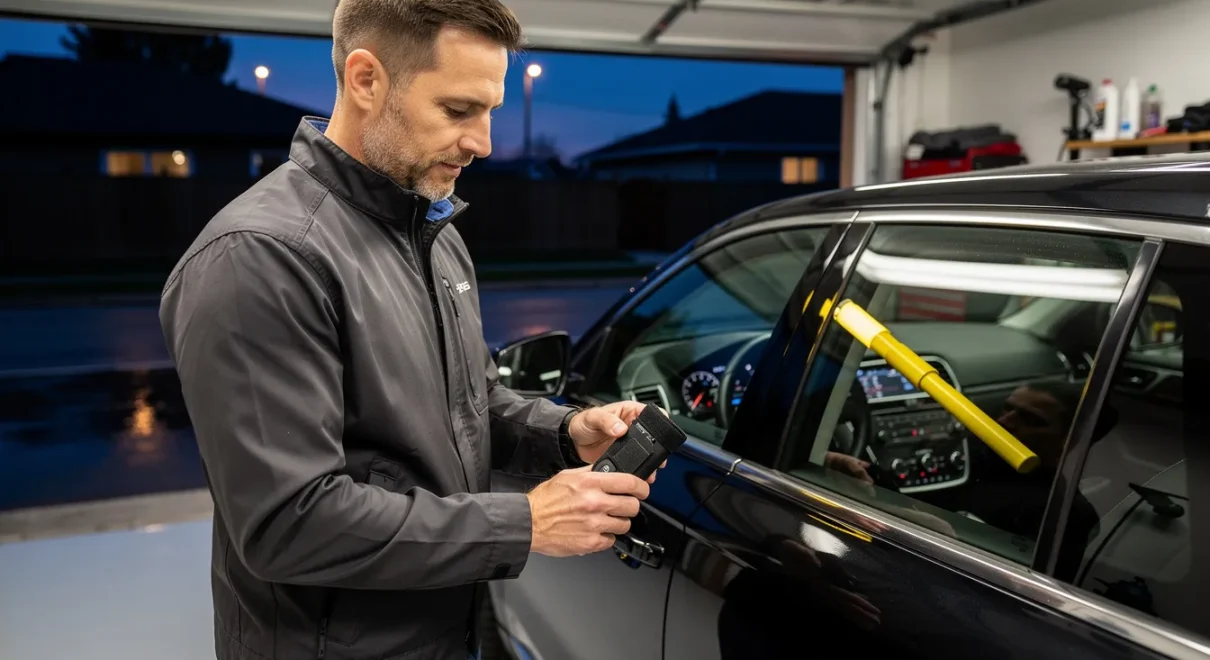
- Steering wheel lock. Old-fashioned, highly visible, and a real deterrent.
- OBD port lock. Blocks access to the diagnostic port used for key programming.
- Aftermarket immobilizer or tracker. Makes the vehicle harder to start and easier to recover. Some insurers offer discounts for them.
- Park smart. Use a garage if you have one. Otherwise, choose a well-lit spot, and park a less desirable vehicle behind the target one.
- Keep the cabin out of view. Thieves shop through the glass. A quality ceramic window tint makes it harder to see what is inside, which discourages smash-and-grab break-ins.
No single measure is perfect. Every extra layer adds time and risk for the thief, and that is usually enough to send them elsewhere.
Quick Checklist
- Both fobs stored in tested Faraday pouches or a box
- Keys kept away from doors and windows
- Fob sleep mode switched on, if available
- Steering wheel lock used overnight
- Valuables out of sight
- Vehicle parked in a garage or a well-lit area
Protect What You Drive
You put real money and care into your vehicle. Five minutes of prevention each night is a small price to keep it in your driveway.
At Left Lane Customs in Scarborough, protecting vehicles is what we do every day, from ceramic tint to paint protection film and coatings. Explore our services or contact us to talk about the right protection for your ride.
Visit us on Facebook at our Facebook Link and our Instagram Link. Left Lane Customs Inc.