


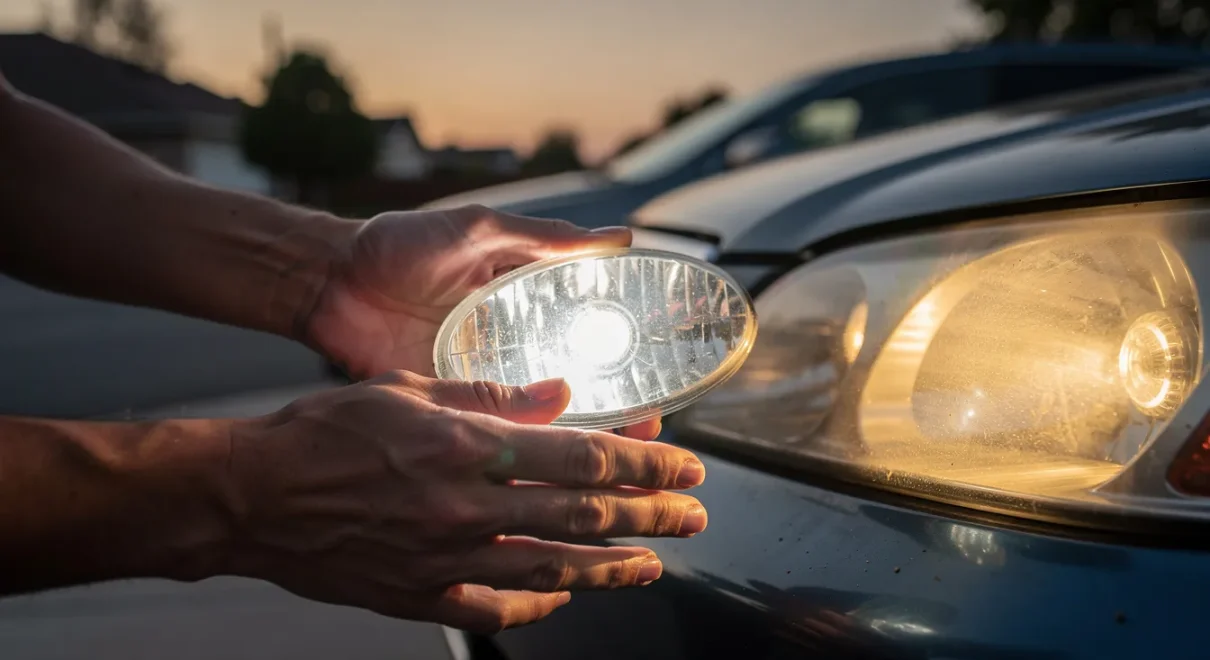
Your Headlights Are Only Working at 22%: Why Headlight Maintenance Actually Matters
Walk through any parking lot in the GTA and count the headlights that look foggy, yellowed, or dull. It’s most of them. And the scary part isn’t how they look — it’s how little light they’re actually putting on the road.
AAA laboratory testing found that deteriorated headlights produce as little as 22% of the light output of new ones — an 80% drop in visibility that most drivers have no idea they’re driving with every night. Headlights aren’t just a cosmetic detail. They’re one of the most overlooked safety systems on your car, and here’s why keeping them in real working condition matters more than most people realize.
Why Headlights Deteriorate in the First Place
Modern headlight lenses aren’t glass — they’re polycarbonate plastic with a thin protective UV coating baked on at the factory. That coating is doing more work than people assume. Over time, constant sun exposure breaks the coating down, and once it’s compromised, the plastic underneath starts to oxidize. That’s what causes the yellowing and clouding you see on older vehicles.
Road grime, salt spray, and stone chips speed the process along, which is part of why it hits Toronto vehicles especially hard between winter road salt and summer UV exposure. Deterioration can start showing up in as little as three years, and by five years it’s noticeable on most vehicles that spend time parked outside.
The Real Cost of Ignoring It
This isn’t just a “your car looks older” problem. The IIHS has directly tied headlight quality to crash outcomes: vehicles with good-rated headlights see 19% fewer nighttime single-vehicle crashes, 29% fewer driver-injury crashes, and 23% fewer pedestrian crashes compared to vehicles with poor-rated headlights. When roughly half of all traffic fatalities happen after dark, that’s not a small difference — it’s the gap between spotting a pedestrian in time and not.
It also matters in exactly the conditions where you can least afford reduced visibility. We covered this in our recent guide on what every driver should do the moment heavy rain hits — Ontario’s Highway Traffic Act requires full headlights any time visibility drops below 150 metres in rain, fog, or snow. Hazy lenses cutting your output by 80% completely defeats the purpose of that law, right when you need every bit of light you can get.
It’s Not Just About Seeing — It’s About Being Seen
Most drivers only think about headlights in terms of how far down the road they can see. But the other half of the equation is just as important: whether other drivers, cyclists, and pedestrians can see you coming. Dim, yellowed, or misaligned headlights make your car harder to spot at intersections, in heavy rain, and on unlit residential streets — exactly the situations where a split-second of recognition matters most.
Headlight aim matters here too. A headlight that’s angled too low wastes light on the pavement a few metres ahead; one that’s angled too high can blind oncoming traffic without actually improving your own visibility. If it’s been a while since anyone’s checked your alignment, it’s worth having it looked at along with the lenses themselves.
Signs Your Headlights Need Attention
A few things worth checking on your next walk around the car:
- Yellowing or cloudiness on the lens itself, even if the bulb still works fine
- Visibly dimmer light compared to when the car was newer
- Moisture or condensation building up inside the housing
- Uneven brightness between your two headlights
- A cracked or pitted lens from stone chips, which accelerates further oxidation
If you’re doing a broader pre-drive inspection anyway, headlight condition is worth adding to the list. Our checklist of what every Toronto driver should check before summer driving covers several other commonly-skipped items that are just as easy to overlook.
Restoration vs. Replacement: What Actually Works
Once headlights are cloudy, there are two real paths forward. DIY restoration kits — sandpaper, a clarifying compound, and a UV-protective topcoat — typically recover about 70% of lost light output and cost relatively little. It’s a reasonable fix if the lenses are hazy but not cracked or deeply pitted.
Full replacement restores light output closer to 100%, since you’re starting with a fresh, undamaged lens and coating rather than working around existing sun damage. It costs more upfront but is the more complete fix, especially on older vehicles where the plastic itself has become brittle.
Either way, this isn’t a once-and-done fix — a proper UV-protective topcoat needs to be reapplied periodically, the same way exterior paint benefits from ongoing protection. If you’re already handling regular exterior care, it’s worth folding headlight upkeep into that same routine. Our DIY car wash guide covers the kind of professional-grade habits that keep the rest of your exterior — lenses included — from deteriorating faster than it needs to.
Don’t Forget What’s Watching Through Them
There’s one more reason clear headlights matter that most drivers never think about: if your vehicle has a forward-facing dash cam, the quality of light your headlights throw directly affects how usable that footage is at night. A dim, yellowed headlight doesn’t just hurt your own visibility — it can leave your camera system working with less to see by. We get into this more in our guide on why your car’s camera system is worth more than you think, and clear, properly maintained headlights are part of what makes that footage actually useful when it counts.
Headlight maintenance rarely makes anyone’s to-do list, but the numbers make a strong case for changing that. An 80% drop in visibility isn’t a minor inconvenience — it’s a real safety gap that’s fully preventable with a restoration kit, a replacement, or just paying attention to what your headlights actually look like at night.
Not sure whether your headlights need restoration or replacement? Book a visit with Left Lane Customs and we’ll take a look before the nights get any longer.
Visit us on Facebook at our Facebook Link and our Instagram Link. Left Lane Customs Inc.