


What to Do If Your Brakes Fail While Driving (And How to Make Sure They Never Do)
It’s the kind of thought that creeps in at the worst possible moment — you’re merging onto the Gardiner, or rolling down the on-ramp to the 401, and for a split second you wonder: what would I actually do if my brakes failed right now?
If that question has ever crossed your mind, you’re not being paranoid. You’re being a driver who pays attention. Brake failure is rare, but it’s also one of the few mechanical problems that can turn a normal commute into a life-threatening emergency in seconds. The good news is that almost every case of brake failure gives warning signs long before the pedal actually fails — and knowing what those signs are, plus what to do in the moment, is what separates a scary story from a real one.
Why the Fear Is Worth Taking Seriously
Toronto drivers deal with a brutal combination of stop-and-go traffic, steep parking garage ramps, salt-heavy winters, and highways where everyone is doing 120 km/h. That’s a lot of repeated stress on a system that most people never think about until it stops working.
Total brake failure is uncommon precisely because modern vehicles are built with redundancy — most cars have dual hydraulic circuits, so losing pressure in one line doesn’t usually mean losing all your brakes at once. But “uncommon” isn’t “impossible,” and the most common real-world causes are things that build up quietly over months:
- Worn brake pads that go past their wear indicators and start damaging the rotors
- Brake fluid leaks from a cracked line, worn seal, or corroded caliper
- Air in the brake lines, which makes the pedal feel soft or “spongy”
- Overheated brakes from riding the pedal too long on a steep grade
- Corrosion, which is a much bigger issue in a city that salts every road from November to March
That last one matters more than most drivers realize. Salt doesn’t just attack your paint and undercarriage — it works its way into brake lines, calipers, and rotors over years of winter driving, which is part of why a proactive approach to brake maintenance matters so much more here than in a drier climate.
What Actually Happens Before Brakes Fail
Almost nobody experiences brakes failing with zero warning. In the vast majority of cases, there’s a buildup of symptoms that get ignored, dismissed, or explained away as “probably nothing.” Here’s what to watch for:
The pedal feels different. A brake pedal that sinks slowly to the floor, feels spongy, or needs to be pumped before it grips properly is telling you there’s air or a leak somewhere in the hydraulic system.
Grinding, squealing, or scraping. A high-pitched squeal usually means your pads are near the end of their life. A grinding or scraping sound means they’re already gone, and metal is now wearing against metal — your rotors. This is a sound you’ll really only need to hear once to never want to hear again.
The car pulls to one side when braking. This often points to uneven wear, a stuck caliper, or a problem affecting only one side of the braking system.
A burning smell after hard braking or a long downhill stretch. This is a sign of overheating, which temporarily (or permanently) reduces braking power — a phenomenon called brake fade.
The dashboard brake warning light is on. It exists for exactly this reason. Don’t treat it like background noise.
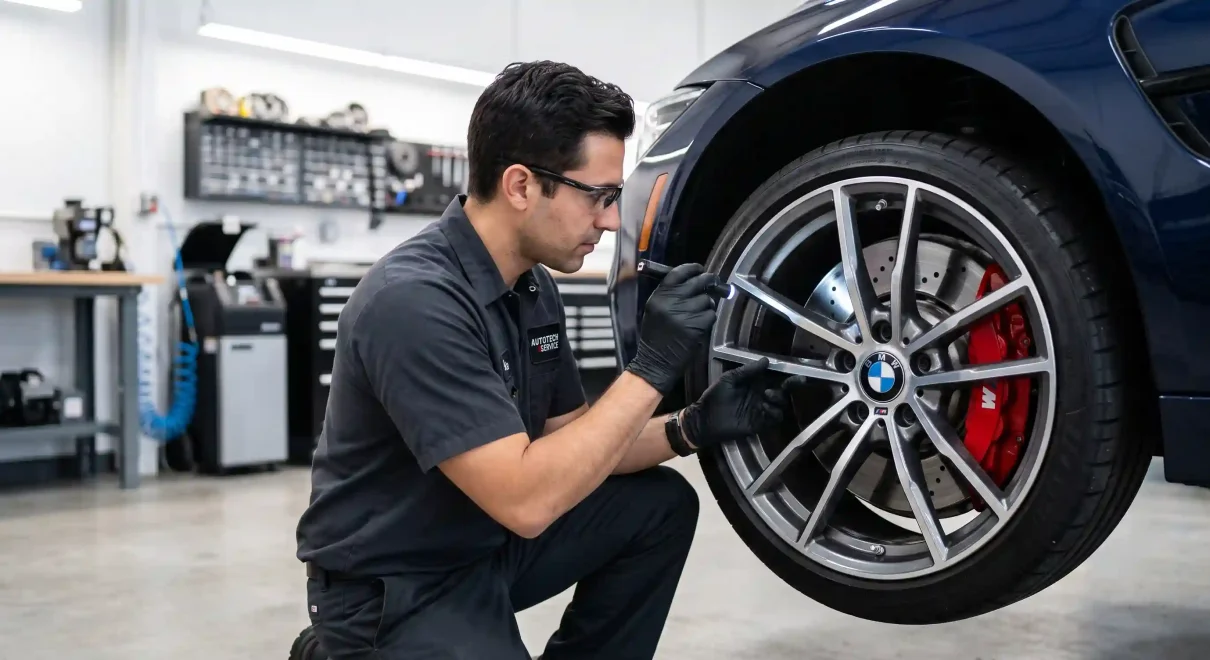
If you’ve noticed any of these and have been putting it off, this is the moment to stop putting it off. A full braking system inspection covers far more than just the pads — rotors, calipers, lines, and fluid condition all play a role in whether your brakes perform the way they’re supposed to when you actually need them.
If Your Brakes Fail While You’re Driving
This is the part everyone hopes they’ll never need, but it’s worth knowing cold:
- Don’t panic, and don’t slam the gas or jerk the wheel. Sudden, sharp movements at speed are how a brake problem turns into a collision.
- Pump the brake pedal repeatedly. If you’ve lost hydraulic pressure, rapid pumping can sometimes rebuild enough pressure to slow the car, even partially.
- Downshift. If you’re in an automatic, manually shifting to a lower gear uses engine braking to slow the vehicle without relying on the brake system at all. In a manual, shift down progressively rather than all at once.
- Use the parking/emergency brake gradually, not in one hard pull, which can lock the rear wheels and cause a skid — especially dangerous on wet or icy pavement.
- Steer toward an escape route. Look for a runaway lane, a clear shoulder, an open field, or even a guardrail you can use to scrub off speed as a last resort. Anything is better than a head-on collision.
- Turn on your hazard lights as soon as you safely can, to warn drivers behind and around you.
- Once stopped, do not drive the car again. Call for a tow. A vehicle that’s lost braking power needs a proper inspection before it goes anywhere near a road again.
This isn’t a sequence you should ever need to use. But knowing it — really knowing it, not just reading it once — is the difference between freezing up and reacting.
The Best Brake Emergency Is the One That Never Happens
The honest truth is that almost every brake failure story you’ll ever hear started with a warning sign that got ignored for weeks or months. A squeal that was “probably fine.” A soft pedal that “just needs topping up.” A dashboard light that got covered with electrical tape (yes, this really happens).
Catching problems early isn’t just about avoiding a worst-case scenario on the highway — it’s also about avoiding a much bigger repair bill down the road. A worn pad that’s caught early costs far less to fix than the warped rotor or seized caliper that follows it if left alone.
If you’re already due for routine maintenance, this is also a good time to think about the bigger picture of vehicle upkeep. Regular care — from a thorough full detail and inspection to long-term protection like a ceramic coating that helps shield your undercarriage components from the road grime and salt that accelerates corrosion — all plays a part in keeping your car reliable for the long haul. Many drivers are also surprised by how much tire condition affects braking distance, since even perfect brakes can’t help much if your tires can’t grip the road.
If something about your brakes — a sound, a feeling, a light on the dash — has been nagging at you, that instinct is worth listening to. Book an inspection, get it checked, and turn that “what if” into peace of mind instead of a roadside emergency.
Worried about your brakes or any part of your vehicle’s safety? Get in touch with our team and let’s get it looked at before it becomes a problem.
Visit us on Facebook at our Facebook Link and our Instagram Link. Left Lane Customs Inc.